

Theater is so cool.
My five days in South Paris, Maine, studying Suzuki Technique, Viewpoints, and Composition

I pulled unfamiliar bedsheets off my face, birds were chirping outside my window, and I noticed my roommate was already gone.
You never can tell what will come in useful,
Who would have thought the wrongs I’ve done
Would save me when the night came on.
But yet there's a saying that still is true-
As long as there’s life, there's hope.
As I scrambled to get dressed,I recalled a passage from Ibsen’s Peer Gynt that was assigned to us a few days before.
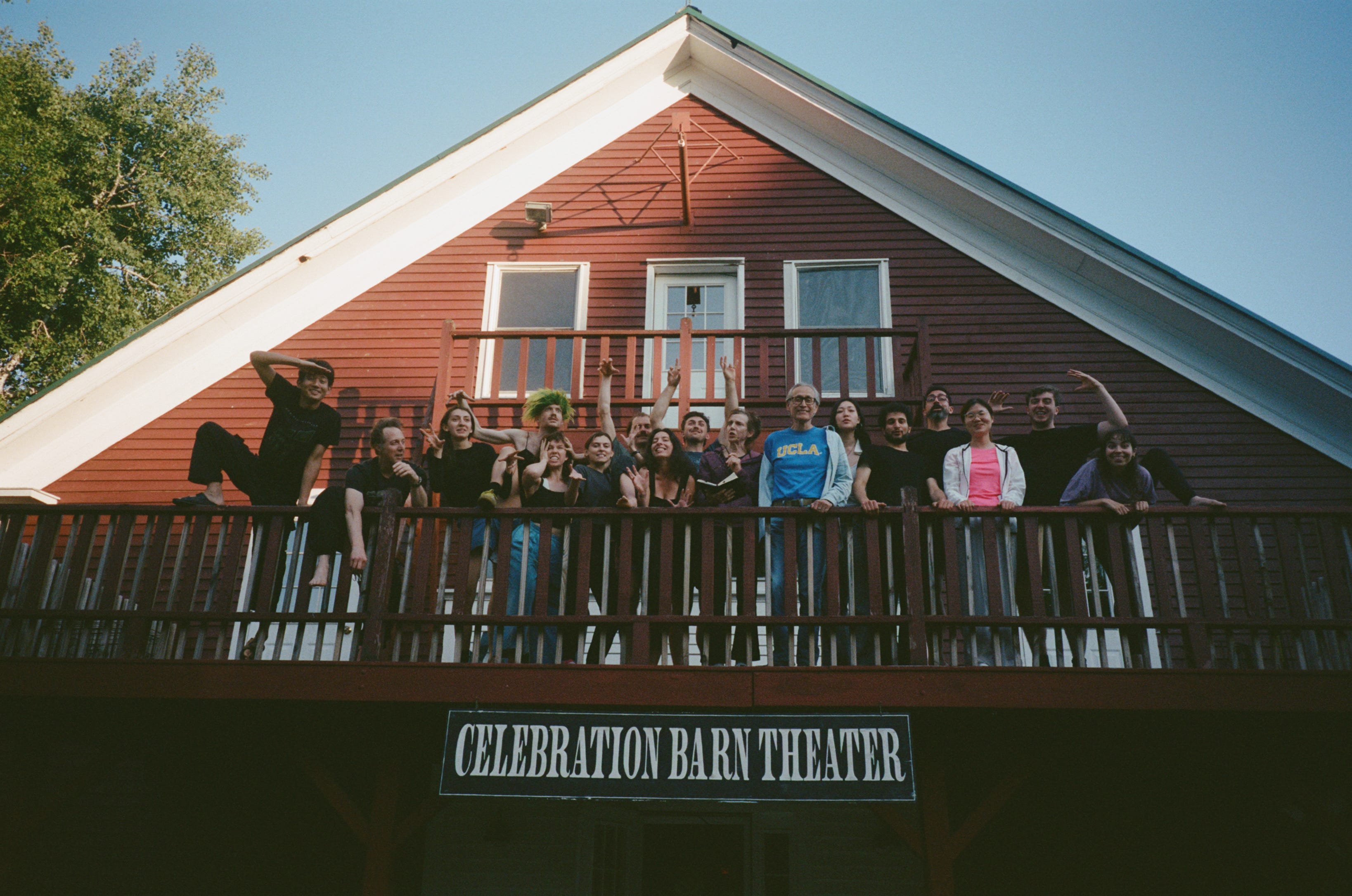
It was Monday morning at the Celebration Barn in South Paris, Maine.
We were here to practice the Suzuki Technique, Viewpoints, and Composition. Three techniques that prepare the actor, facilitate group ensemble, and generate new theater works, respectively.
The week was a mind-altering experience. And the following are my takeaways. As a disclaimer, the following are in no way an authoritative account of these techniques - these are my subjective thoughts, that I felt important to record and publish while the experience was fresh in my mind.
The Suzuki Technique
What does an actor’s body need to do? That seems to be the question that the Suzuki Technique attempts, and in my opinion, does a pretty good job answering.
In practice, what you will see is a bunch of people stomping around, with a serious gaze. Walking slowly… with a serious gaze. Kicking their legs up and down…with a serious gaze. It’s a lot of serious gazing.
Why?
The main point of these exercises is for the actor to understand what their body is doing, and how their body is occupying space. To do this, the actor must cultivate a strong sense of connection with their body, having a 360 degree view of how their body exists.
In the world of Zoom calls and selfies, a lot of actors have an awareness of how their face and upper body looks from one angle, but they don’t know how their entire physical being looks as a whole. Suzuki’s technique pushes the human body to sustain a pose, a stance, and a rate of movement through space. These criteria as proposed by the technique, are extremely difficult to perform.
Quite frankly, they are designed to be impossible. But by attempting the impossible, the body starts to signal to us, telling us where the body is failing to meet the criteria.
For me, for example, whenever I was doing any pose, or walking, I was told that my spine was collapsed, and my shoulder was tense and round. After five days of doing the technique however, I began to feel that my spine was collapsed, and my shoulder was rounded. Don’t get me wrong, my spine is still collapsed, and my shoulders are still round, but at least, I began to feel that.
This is helpful. Afterall, when you are on a film set and on the stage, you don’t have mirror with you. The cultivation of this awareness allows us to know what our body is doing, what our body is saying.
“To be on stage is an extremely subversive act,” said Ellen Lauren, one of our two amazing instructors. To just exist on stage is an act of subversion. But if we don’t know how we are existing on stage, what is the message we are sending? We won’t know, and it would be left to chance.
To be on stage is a privilege. And with funding for the arts being slashed by the government (in the US), stage time is more and more scarce and precious. To not understand our body’s presentation on stage is leaving our subversive message up to chance - it is absolutely critical, now more than ever, to understand and have a connection to our bodies so that we are delivering whatever message we wish to deliver with crystal clear intent.
Suzuki is a technique that trains our bodies to understand our body’s message.
Viewpoints
Every community has something that can’t be said without sparking intense debate. In West Africa, it’s any statement comparing jollof rice quality between Ghana and Nigeria. (Just don’t, and if you are surrounded by Nigerians, say that theirs is better…and vice-versa.)
And in the realm of devised experimental theater, controversy erupts when it involves any comparison between Mary Overlie’s or Anne Bogart and Tina Landau’s “Viewpoints”. Overlie’s has six. Bogart and Landau have nine. Both are fine systems. We studied Bogart and Landau’s nine. And I’m pretty sure I already pissed off a bunch of people even with that relatively innocuous statement.
If theater is a painting, with many colors and shades, the nine viewpoints are like nine colors that actors are encouraged to play around with. And they are:
Architecture: The physical environment, the space, and whatever belongs to it or constitutes it, including permanent and non-permanent features.
Spatial Relationship: Distance between objects on stage; one body in relation to another, to a group, or to the architecture.
Topography: The movement over landscape, floor pattern, design and colours.
Shape: The contour or outline of bodies in space; the shape of the body by itself, in relation to other bodies, or in relation to architecture; lines, curves, angles, arches all stationary or in motion.
Gesture: a) Behavioral gesture: realistic gesture belonging to the physical world as we observe it every day. b) Expressive gesture: abstract or symbolic gesture expressing an inner state or emotion; it is not intended as a public or "realistic" gesture.
Tempo: How quickly or slowly something happens on stage.
Duration: How long an event occurs over time; how long a person or a group maintains a particular movement, tempo, gesture, etc. before it changes.
Kinesthetic Response: A spontaneous reaction to a motion that occurs outside of oneself. An instinctive response to an external stimulus (realistic/non-realistic).
Repetition: a) Internal Repetition: repeating a movement done with one's own body, and b) External Repetition: repeating a movement occurring outside one's body.
Source: Bogart, Anne; Landau, Tina (2004). The Viewpoints Book: A Practical Guide to Viewpoints and Composition.
So what do we do with these colors? We choose two, or maybe three. Put on some music and start improvising. Say we choose architecture, tempo, and repetition. Then we have actors playing around with the space, altering their movement’s speed, and sometimes repeating things, sometimes not.
What was amazing to me, was that by the end of five days, our group started to use the elements in a cohesive style. We developed a language of physical movement that allowed us to communicate and get in sync with each other, without words. Our cohort had a variety of nationalities, languages, and personality types represented, but by the end of the five days, we understood each other at a deeper level.
In one such Viewpoints session, five of us were on the stage. I don’t quite remember which Viewpoints we focused on, but there was a moment where we all faced one direction in a line. Apart from the person in the very back, we couldn’t see all of us at the same time. We froze for 20 seconds. And something within me knew that we will start marching, at a slow steady pace…soon. A few more seconds passed. Not now. A few more seconds…Now! We all took a step at the same time. Our senses were so in tune with one another, we just knew what we needed to do and when.
We were an ensemble. A tribe. A community. A team.
Composition
Now that we are able to understand the basics of what we individually look like, and also become one as an ensemble… (at least as much as we can do in five days), it was time for composition.
When doing Viewpoints, what’s fascinating is that we start to see stories emerge within the staging. A person might always be surrounded by fast-moving people - is that a storm? A person might always be avoided by others, while they repeatedly run into a wall - is that person ostracized?
These are things that we would take notes on. We would notice formations and movements that make us feel a certain way. And we would take note of them, without judgement.
We were also reading Peer Gynt, the epic play by Henrik Ibsen. We memorized a few scenes. Scenes that felt moving for whatever reason. And as we were doing our viewpoints, we would find moments where the text would just pour out of us. The scenes that we memorized would just feel right. I could be hanging from a rafter, my scene partner can be under the chairs, and then a scene would pop into our heads and we would perform them. It’s as though we were pulling the story out of some shared dramaturgical ether.
Then in the last two days, we were told to stage a version of Peer Gynt - with the following prompts in mind:
Why is a troll a troll, and can we change our nature?
10 seconds of sobbing.
10 seconds of laughter.
Silence.
10 to 12 minutes long.
Use as much of the text as possible.
An “escape”
An encounter with the unknown.
Stay in the building.
Farewell to a loved one.
A scene of domesticity.
A transactional exchange.
A scene of waiting.
With these ideas in mind, we got to work. Mind you, our schedule was 9am - 12pm Suzuki. 12pm to 3pm Viewpoints. And then from 3pm to sometimes 1am, we were devising, composing, and making theater.
After two days, we were done.
Our piece was a beautiful experience. It included puppets, it included pies, 3 aunts, 3 languages, kids going missing, kids finding a way out, it was wild. Clotheslines appearing across the audience’s head, people turning into trolls. And above all else we felt in sync.
It was a trip. It was very Peer Gynt. It was our Peer Gynt.
My Take Aways
Theater is political. It’s extremely subversive. In a world where we are taught to be rugged individualists, capitalist, or otherwise hierarchical, theater rewards community building, and sharing of focus. It requires us to radically accept who we are, all our strengths, our weaknesses, so that we can show up to others as truthfully as we can. This allows us to create a strong community based on trust, and lets us create something that’s greater than the sum of our talented parts. It’s one of the most classless, horizontal, anti-hierarchal things you can do.
As Ellen and J. Ed put it, ideally, we then give a role to the audience. The theater is much like an incandescent bulb, with charged electricity ready to make a connection through the filament. The audience is the filament, the connector, the glue, that brings light to the whole. We set up the bulb, and the audience is there to complete the circuit to light up the room.
There are many many ways to approach theater. Some don’t like horizontalism, they like top-down structures. Story first, writer first, etc. At least for me though I like sharing. I like building together, with no judgement about what’s most important dogmatically imposed upon us from the start of creation. Suzuki, Viewpoints, and Composition, are techniques that allow for art to be devised in a way that is freeing. And I think this is potent especially today against the backdrop of late-stage capitalism, and rising fascism.
Theater creates communities, and for five days in Maine, I was certainly a part of one that I will never forget.

Terrific read. I knew that such frameworks must exist, but knew nothing about them! Thank you for this peek.